Orson Scott Card's Ender's Game is finally going to be made into a movie. I could not be more excited. I might have had a barely contained squeal in the theater the first time I saw a trailer. Love those books. I've loved most everything I've read by Orson Scott Card and I've read most of his works that aren't barely disguised allegories for Mormon theology.
Oh yeah, Orson Scott Card is a member of the church of Jesus Christ of Latter Day Saints, a religion not known for its tolerance. And he was a board member of the National Organization for Marriage until very recently. And by marriage, that group means only heterosexual marriage.
For this and similar reasons, a group of LGBTQ geeks has organized a boycott of Ender's Game called Skip Ender's Game.
I agree with their sentiments, mostly. The New York Times has an editorial that explains it better than I probably will. Basically this is a bit different than the Chik-Fil-A boycott. Their profits were being directly funneled into anti-gay causes. And creators have throughout history had crazy opinions separate from their creations.
That said, it is possible I am making excuses because I really want to see this movie. I don't know. Perhaps the best reason to boycott it is the likelihood it will be a disappointment. I should keep Petra, Ender, Bean, and all my other battleschool friends the way they look in my head.
I could not watch it in theaters and grab the DVD from the library (the library will buy the number of copies it does based on other factors, not my borrowing habits) for free instead of giving it money directly at the theater or indirectly through Netflix.
And it wouldn't end my life to skip it entirely. I'm just not sure that it will make any difference. Do you know what makes a difference in these types of social issues? For every loud mouth bigot, that there are 10 or 100 people quietly living their lives. Because when you know a couple who has been together, committed and in love for years but able to have any legal protections, your mind starts to change. When you realize that it is fine for your church to not perform the marriage, but that has nothing to do with the state defined contract of marriage and those protections, your mind changes. (For example the Catholic church wouldn't marry my husband and I because neither of us are Catholic or willing to raise children Catholic, but they have no problem with the state of Alaska recognizing our marriage.) And when people in the public eye, quietly come out, newscasters and sports figures, actors, child stars, and singers, that is when mind changes. Honestly, I'm not sure Card has as much influence here.
Orson Scott Card has a vivid imagination. Too bad he doesn't stick to science fiction, but instead uses it to imagine that Obama is recruiting an army of urban gang members. Too bad he has some views that I hate. But does that invalidate all of his contributions in terms of artistic merit? As the Times article linked above is this a form of blacklisting because we don't like his politics? Didn't we (rightfully) hate on McCarthy for doing the same thing? Ender's Game has nothing to do with gay marriage, so why can't we enjoy it for what it is?
What is a socially conscious geek girl to do?
Thursday, August 15, 2013


Saturday, August 03, 2013
Body-Positive Self-Esteem Storytime
This is a very quick blog post started by a conversation on Twitter. MagpieLibrarian (aka Ingrid) whom I've never met, but I saw once at ALA and was too shy to say hi, put up a very cool body-positive display in her tween/teen area. You can read all about it here. Also apparently, I am the only person who is hyphenating body positive so I'll stop that.
Then I mentioned that I used to do body positive/self-esteem storytimes as part of my regular rotation of storytimes. There's a million studies out there about negative self-esteem, especially in girls, and how young it starts. We've all seen the articles about the sexualization of Strawberry Shortcake and even My Little Pony. If the marketers are starting that early, anyone who wants to be on the other side of this fight should too. Lest the parents believe I'm pushing an agenda, I call it "I Like Me" storytime.
 I first got the idea for this story from Nancy Carlson's classic book I Like Me where a vivacious pig lists all the things she likes about herself including her round little tummy. She lists all the great stuff she can do, including ride her bike fast, how she keeps trying after she makes a mistake, and the ways she takes care of herself. But my favorite page is where the pig in her pajamas (admittedly a retro baby doll pajama set but not at all a sexualized look) greets herself every morning with "Hi, good-looking!" It usually makes all the moms laugh, but that is in the tone of voice you read, I camp it up.
There are a whole host of great books available for preschoolers to do a storytime. Many of them are short enough that it is possible (I've done it) to use as a lapsit/toddler program. I'm publishing my list from the last time I did this storytime in 2011. And even then I remember not putting all the books in the packet. Clearly we read 3-4 books at storytime, but we made packets for the entire system that had more books so each librarian could choose their favorites.
While I try to keep up with children's literature, I've fallen a bit behind on picture books since I'm now a branch manager. Please comment on if you know any more.
Possible Picture Books to use:
Incredible Me by Kathi Appelt
 I Like Myself! by Karen Beaumont
Nobody Laughs at a Lion by Paul Bright
I Like Me by Nancy Carlson
I'm Gonna Like Me by Jamie Lee Curtis
Alfred's Nose by Vivienne Flescher
Dog Eared by Amanda Harvey
Happy to Be Nappy by Bell Hooks
Leo the Late Bloomer by Robert Kraus
Good Thing You're Not an Octopus by Julie Markes
I'm A Pig by Sarah Weeks
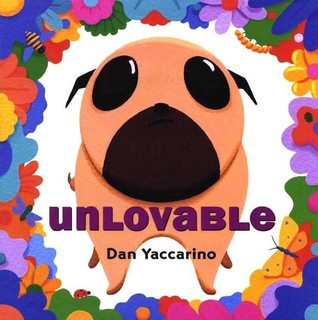
Unlovable by Dan Yaccarino
Flannel board/told stories:
I like to do one flannel or magnet board story at each storytime. It's fun, breaks the rhythm, and helps kids who learn differently. The Ugly Duckling is a really good choice out there. If you're in one of those libraries that has a huge filing cabinet full of flannel boards (man I love those things), odds are better than even that you have one for The Ugly Duckling already.
If you don't, you can make one. I promise. I'm not that artistic (I'm crafty but I can't draw) and I've done it. Or you can cheat and do a magnet board. We had a two sided board with flannel on one side and magnetized white board on the other. Go to the craft store, buy the magnets that come in strips and are sticky on one side. Start googling around for duckling and baby swan (cygnet) templates. (I recommend adding the words "coloring page" to your search.) Print them out the appropriate size. Color in brightly with markers (pinch yourself because you're getting paid to color). Laminate them; if you don't have access to a laminating machine I don't know how you can call yourself a youth services librarian; I laminated everything in sight in my YS days. Attach magnets. Take dry erase markers and draw a lake and some weeds and a nest and some eggs. Voila! Storytelling stage set!
Songs:
Any body song will work here as well any of those rhymes where you "clap your hands, stamp your feet, turn around, take a seat". I'll list a few to get you started.
Heads, Shoulders, Knees and Toes
The Hokey-Pokey (under no circumstances should you ever in your life turn down an opportunity to do the Hokey-Pokey).
Do Your Ears Hang Low?
If You're Happy and You Know It
Shake Your Sillies Out (Raffi)
Here's one of my favorite body movement rhymes (no tune). Make the actions match the words:
 Hands on Shoulders

Then I mentioned that I used to do body positive/self-esteem storytimes as part of my regular rotation of storytimes. There's a million studies out there about negative self-esteem, especially in girls, and how young it starts. We've all seen the articles about the sexualization of Strawberry Shortcake and even My Little Pony. If the marketers are starting that early, anyone who wants to be on the other side of this fight should too. Lest the parents believe I'm pushing an agenda, I call it "I Like Me" storytime.
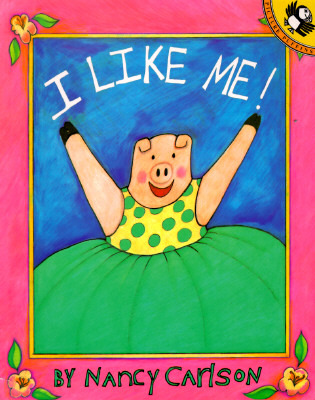
There are a whole host of great books available for preschoolers to do a storytime. Many of them are short enough that it is possible (I've done it) to use as a lapsit/toddler program. I'm publishing my list from the last time I did this storytime in 2011. And even then I remember not putting all the books in the packet. Clearly we read 3-4 books at storytime, but we made packets for the entire system that had more books so each librarian could choose their favorites.
While I try to keep up with children's literature, I've fallen a bit behind on picture books since I'm now a branch manager. Please comment on if you know any more.
Possible Picture Books to use:
Incredible Me by Kathi Appelt
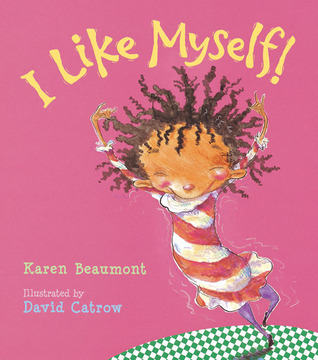
Nobody Laughs at a Lion by Paul Bright
I Like Me by Nancy Carlson
I'm Gonna Like Me by Jamie Lee Curtis
Alfred's Nose by Vivienne Flescher
Dog Eared by Amanda Harvey
Happy to Be Nappy by Bell Hooks
Leo the Late Bloomer by Robert Kraus
Good Thing You're Not an Octopus by Julie Markes
I'm A Pig by Sarah Weeks
Unlovable by Dan Yaccarino
Flannel board/told stories:
I like to do one flannel or magnet board story at each storytime. It's fun, breaks the rhythm, and helps kids who learn differently. The Ugly Duckling is a really good choice out there. If you're in one of those libraries that has a huge filing cabinet full of flannel boards (man I love those things), odds are better than even that you have one for The Ugly Duckling already.
If you don't, you can make one. I promise. I'm not that artistic (I'm crafty but I can't draw) and I've done it. Or you can cheat and do a magnet board. We had a two sided board with flannel on one side and magnetized white board on the other. Go to the craft store, buy the magnets that come in strips and are sticky on one side. Start googling around for duckling and baby swan (cygnet) templates. (I recommend adding the words "coloring page" to your search.) Print them out the appropriate size. Color in brightly with markers (pinch yourself because you're getting paid to color). Laminate them; if you don't have access to a laminating machine I don't know how you can call yourself a youth services librarian; I laminated everything in sight in my YS days. Attach magnets. Take dry erase markers and draw a lake and some weeds and a nest and some eggs. Voila! Storytelling stage set!
Songs:
Any body song will work here as well any of those rhymes where you "clap your hands, stamp your feet, turn around, take a seat". I'll list a few to get you started.
Heads, Shoulders, Knees and Toes
The Hokey-Pokey (under no circumstances should you ever in your life turn down an opportunity to do the Hokey-Pokey).
Do Your Ears Hang Low?
If You're Happy and You Know It
Shake Your Sillies Out (Raffi)
Here's one of my favorite body movement rhymes (no tune). Make the actions match the words:
Hands on shoulders
Hands on knees
Hands behind you, if you please
Touch your elbows
Then your nose
Touch your hair
Now touch your toes.
Raise hands up high
Wave hello
Stretch your arms (arms to the side)
And watch you grow
Then bring hands down
Touch the floor
Now clap your hands,
ONE TWO THREE FOUR!
And one song I wrote (use however you want, just give me, Elizabeth Moreau Nicolai, credit if print)
I Like Me
(to the tune of "Three Blind Mice")
I Like Me (point to self)
I Like Me
So Very Much (hug ones self)
So Very Much
I can jump up high and touch the sky (jump up with arms pointing up)
I can jump up high and touch the sky
I Like Me
I Like Me
Following verses, all the same except third stanza which you substitute for other actions. Here are two of my favorites.
I can run faster than a tiger (jog in place)
I can dance and do the twist (dance, twist)

Craft:
Clearly you need to have outlines of body shapes (the generic could be a girl or boy one) and let the kids color themselves. For more fun, have random shapes of random colors of paper and they can glue them on for clothes. I used to save all my random scraps of paper for this and making monsters. Recycling! Go fancy with yarn to glue on for hair and googly eyes or eye stickers. Best storytime ever: a little girl glued on purple hair because someday she would have purple hair but mommy wouldn't let her now. I hope she got it.
There you go, a super fun, easy storytime to promote body positive thinking! Happy Reading!
Friday, August 02, 2013
Review - Life After Life
Sometimes I like to pair books with audiobooks the way other people pair wines with meals. I paired this with Cloud Atlas by David Mitchell (on audio) and it was a lovely matching. Reincarnation that isn't quite reincarnation in both cases. Beautiful combination.
 Life After Life by Kate Atkinson. 529 pages. Published in April 2013 by Reagan Arthur Books.
Bottom Line: I can not say enough good things about this book. It's a wonderful character based relationship drama, beautifully written with a fascinating plot device. Will appeal to fans of Kate Morton. Good choice for book clubs. Recommended for all libraries.
In 1910 Ursula Todd is born and dies due to a cord wrapped around her neck. But then again on that same night she is born and this time the doctor makes it to her house and she lives. So it goes throughout her life, she dies and the next time manages to change events. Vague memories of previous lives haunt her with a constant since of deja vu. But with a life that spans two wars, a depression, and a flu epidemic can she use this to change more than just her own fate and that of the ones she loves?
This is a seriously fantastic concept. I've never seen reincarnation approached in quite this way before (the closest perhaps is The Butterfly Effect but this is much better done). The reliving of lives leaves Ursula able to make different choices as she grows older and as such affect not only if she lives, but those around her. Of course her constant since of deja vu leads to its own problems.
The language Atkinson uses is beautiful, it is as repetitive and circular as is Ursula's life resulting in a melancholy, ethereal quality. Such revisits and repeats of scenes as we relive Ursula's life could be tiresome and redundant, but they aren't. With each return to a scene it is framed slightly differently and we learn something new about the characters. It's brilliant.
The setting is ideal for such a plot device. A girl who watches her father fight in one world war, the entire world set back by a flu epidemic, and then her brothers and friends fight in another world war is uniquely poised to do something if she has a pre-knowledge of history. England of the countryside and London are starkly rendered. I felt as cold and bone-weary as Ursula did as she searched bombed buildings for survivors during the Blitz.
And let's talk about the ending. (No spoilers, promise!) When you have a main character who constantly gets to relive her own life, it would be possible to never end your story and almost impossible to really end it. While everyone of the 529 pages are worth it, I did wonder how she would end it. And how she did still leaves you with a lot of questions, but also a lot of satisfaction. I chose to believe that each time she restarted and changed something she created a new parallel universe, but I read too much scifi. And thus we ended in the universe that the author wanted us to live in.
Please note this book is not scifi by any stretch of the imagination. I'm sure it gets classified as "women's lit" but I hate that term. I'm going with literary fiction because of how wonderfully written and carefully constructed it is. Just go read it.

Bottom Line: I can not say enough good things about this book. It's a wonderful character based relationship drama, beautifully written with a fascinating plot device. Will appeal to fans of Kate Morton. Good choice for book clubs. Recommended for all libraries.
In 1910 Ursula Todd is born and dies due to a cord wrapped around her neck. But then again on that same night she is born and this time the doctor makes it to her house and she lives. So it goes throughout her life, she dies and the next time manages to change events. Vague memories of previous lives haunt her with a constant since of deja vu. But with a life that spans two wars, a depression, and a flu epidemic can she use this to change more than just her own fate and that of the ones she loves?
This is a seriously fantastic concept. I've never seen reincarnation approached in quite this way before (the closest perhaps is The Butterfly Effect but this is much better done). The reliving of lives leaves Ursula able to make different choices as she grows older and as such affect not only if she lives, but those around her. Of course her constant since of deja vu leads to its own problems.
The language Atkinson uses is beautiful, it is as repetitive and circular as is Ursula's life resulting in a melancholy, ethereal quality. Such revisits and repeats of scenes as we relive Ursula's life could be tiresome and redundant, but they aren't. With each return to a scene it is framed slightly differently and we learn something new about the characters. It's brilliant.
The setting is ideal for such a plot device. A girl who watches her father fight in one world war, the entire world set back by a flu epidemic, and then her brothers and friends fight in another world war is uniquely poised to do something if she has a pre-knowledge of history. England of the countryside and London are starkly rendered. I felt as cold and bone-weary as Ursula did as she searched bombed buildings for survivors during the Blitz.
And let's talk about the ending. (No spoilers, promise!) When you have a main character who constantly gets to relive her own life, it would be possible to never end your story and almost impossible to really end it. While everyone of the 529 pages are worth it, I did wonder how she would end it. And how she did still leaves you with a lot of questions, but also a lot of satisfaction. I chose to believe that each time she restarted and changed something she created a new parallel universe, but I read too much scifi. And thus we ended in the universe that the author wanted us to live in.
Please note this book is not scifi by any stretch of the imagination. I'm sure it gets classified as "women's lit" but I hate that term. I'm going with literary fiction because of how wonderfully written and carefully constructed it is. Just go read it.
Saturday, July 27, 2013
Review - The Light in the Ruins
Having read a plethora of books about the English, French, American, and German experience in WWII, it was a surprise to me to realize how little I knew about the Italian side of things. Enter The Light in the Ruins which is set alternatively at the end of the Italian fighting in 1943 and over a decate later in 1955 when the country is trying to rebuild.
 The Light in the Ruins by Chris Bohjalian. Published July 2013 by Doubleday. 309 pages. I received an advanced ebook copy for the purposes of review.
Bottom Line: An enjoyable summer read that nicely blends elements of relationship based fiction, historical fiction, and murder mystery genres for a lot of cross appeal. Recommended to medium sized and above public libraries. Will appeal to fans of everything from Jodi Picoult to Iris Johansen
In 1955 Italy a serial killer is tracking down and murdering the members of the once noble Rosati family. As the investigation proceeds, the detective realizes it might have something to do with the final days of the German occupation of Italy and her own tortured past as a partisan Italian freedom fighter. Jumping between 1943 and post-war Italy, you learn the story of the Rosati and their villa on top of ancient ruins, Germans, Nazis, partisan rebels, and the impossible choices war forces upon us all.
What if you were 18 and there were no men your age around due to war? No parties? No socialization opportunities? Would you fall in love with a handsome German, even a Nazi soldier? What if you were 18 and you lost your entire family to the Nazis? Could you go back to your "normal" life or would you join us with the rebel factions fighting for freedom? What if that fight meant innocent people would die?
Different women, different choices. And at the heart of the wonderful novel is the choices we make when life is impossible. I found it to be an authentic and heartfelt novel.
The characters, especially that of Cristina Rosati and Serafina Bettini (the partisan/detective) were really well developed. (Insert obligatory note wherein I'm surprised at how well a male author writes female characters.) The supporting characters were also well flushed out. At times only hints of characters and stories were given, and the glimpse of a larger story added to the authenticity of the setting/characters--even if it somewhat frustrated me, but I'm a completionist.
The setting wasn't enough there for me. This book focused so much on character development that I felt the setting was somewhat lacking. There were wonderful descriptions of the villa in the 40s, the ruins, and the countryside, but not much of Italy in 1955. I had a lot of questions. How was the recovery going? Economics? Are there still bomb shattered buildings around or has it mostly been rebuilt? I got much less of a sense of Italy a decade past war and that is too bad because I would have been interested in it. There are a few hints about which tourists have the money to travel, some passing comments about what people were doing during the war and how that affects them now, but it was scarce compared to the war time descriptions. Probably the weakest part of the book.
And on the plot? The plot was page turning (to use a cliche). The back and forth between time frames, while often overused, worked to build suspense and gradually reveal the next necessary details. I'm more ambivalent about the two pages in between each chapter that were told in first person from the point of view of the serial killer. It didn't do much to reveal his identity or add to his character development once his identity was revealed. And it didn't add to the overall tension of the book. Those interludes were just there. Perhaps what the author was trying to do with them could have (or actually was) done by the rest of the text and that is why they felt superfluous.
In general, I enjoyed this book. Great choice for a summer read and it quite nicely bridges the line between historical fiction/women's literature and murder mystery. I didn't think of it as a murder mystery, but it would appeal to mystery fans.

Bottom Line: An enjoyable summer read that nicely blends elements of relationship based fiction, historical fiction, and murder mystery genres for a lot of cross appeal. Recommended to medium sized and above public libraries. Will appeal to fans of everything from Jodi Picoult to Iris Johansen
In 1955 Italy a serial killer is tracking down and murdering the members of the once noble Rosati family. As the investigation proceeds, the detective realizes it might have something to do with the final days of the German occupation of Italy and her own tortured past as a partisan Italian freedom fighter. Jumping between 1943 and post-war Italy, you learn the story of the Rosati and their villa on top of ancient ruins, Germans, Nazis, partisan rebels, and the impossible choices war forces upon us all.
What if you were 18 and there were no men your age around due to war? No parties? No socialization opportunities? Would you fall in love with a handsome German, even a Nazi soldier? What if you were 18 and you lost your entire family to the Nazis? Could you go back to your "normal" life or would you join us with the rebel factions fighting for freedom? What if that fight meant innocent people would die?
Different women, different choices. And at the heart of the wonderful novel is the choices we make when life is impossible. I found it to be an authentic and heartfelt novel.
The characters, especially that of Cristina Rosati and Serafina Bettini (the partisan/detective) were really well developed. (Insert obligatory note wherein I'm surprised at how well a male author writes female characters.) The supporting characters were also well flushed out. At times only hints of characters and stories were given, and the glimpse of a larger story added to the authenticity of the setting/characters--even if it somewhat frustrated me, but I'm a completionist.
The setting wasn't enough there for me. This book focused so much on character development that I felt the setting was somewhat lacking. There were wonderful descriptions of the villa in the 40s, the ruins, and the countryside, but not much of Italy in 1955. I had a lot of questions. How was the recovery going? Economics? Are there still bomb shattered buildings around or has it mostly been rebuilt? I got much less of a sense of Italy a decade past war and that is too bad because I would have been interested in it. There are a few hints about which tourists have the money to travel, some passing comments about what people were doing during the war and how that affects them now, but it was scarce compared to the war time descriptions. Probably the weakest part of the book.
And on the plot? The plot was page turning (to use a cliche). The back and forth between time frames, while often overused, worked to build suspense and gradually reveal the next necessary details. I'm more ambivalent about the two pages in between each chapter that were told in first person from the point of view of the serial killer. It didn't do much to reveal his identity or add to his character development once his identity was revealed. And it didn't add to the overall tension of the book. Those interludes were just there. Perhaps what the author was trying to do with them could have (or actually was) done by the rest of the text and that is why they felt superfluous.
In general, I enjoyed this book. Great choice for a summer read and it quite nicely bridges the line between historical fiction/women's literature and murder mystery. I didn't think of it as a murder mystery, but it would appeal to mystery fans.
Saturday, July 20, 2013
Now I Need to Learn Romanian
Here's a little story that might amuse you on a Saturday.
Once upon a time, when I was a younger librarian, I noticed that Hilary Mantel had won the 2009 Man Booker Prize for Wolf Hall. A historical novel based on the life of Thomas Cromwell? Exactly up my alley, my very boring, geeky alley. I made a note to read it, but promptly forgot about it for the next shiny novel.
Then Hilary Mantel got into hot water for some comments she made about Kate Middleton. And I noted she had a new book, Bring Up the Bodies, a continuation of her series about Thomas Cromwell. (Honestly I had forgotten about the first book, but when I looked up the second it all came flooding back.)
The second book had also won the Man Booker Prize. At this point I double checked that the Man Booker prize was what I thought it was and they weren't just giving it out like candy. It is the prize for the best full length original novel in the English language by a citizen of the Commonwealth of Nations won it twice in the last five years. That's crazy.
Clearly I have to read those books. They're between 400 and 700 pages each. That's a lot of weight in a hardcover novel. And my days of lugging around huge hardcovers are over. So I logged online to check it out as an ebook or downloadable audio from the library's system.
No audio. Bummer, that's my preferred method for long books - it got me through Atlas Shrugged and Middlemarch. Hey we have the ebook! Click on it and in that split second before I check it out I notice I can't read the description.
Closer inspection, it's in Romanian. We only own the ebook of the best English language novel of 2009 in Romanian.
Quick google to make sure I haven't missed a large Romanian population lurking around Alaska. Nope.
Email the librarian in charge of buying ebooks (through Overdrive if you're curious about those things). It's only available for purchase in Romanian. Someone (not this librarian but we're not investigating too closely who since we are partners with about 20 other libraries in our ebook system) didn't look too closely and bought the only listing of the ebook without noticing it was in Romanian.
One more quick search. It's published by Macmillan which doesn't allow its ebooks to be bought by libraries. (That's an entire other discussion.) But they have started a new project allowing ebooks to go to libraries through Overdrive (and other vendors). So far it is mostly crime novels, but I am holding out hope. I can wait until they decide to offer it, even though that might be a few years.
Or should I get over my lazy self and just carry around the huge hardbacks? Or get over my cheap self and buy either the paperbacks or ebooks? (For a librarian, I don't own a ton of books. That's what I use the library for.)
Moral of the story: check the language before you buy ebooks.
Once upon a time, when I was a younger librarian, I noticed that Hilary Mantel had won the 2009 Man Booker Prize for Wolf Hall. A historical novel based on the life of Thomas Cromwell? Exactly up my alley, my very boring, geeky alley. I made a note to read it, but promptly forgot about it for the next shiny novel.
Then Hilary Mantel got into hot water for some comments she made about Kate Middleton. And I noted she had a new book, Bring Up the Bodies, a continuation of her series about Thomas Cromwell. (Honestly I had forgotten about the first book, but when I looked up the second it all came flooding back.)
The second book had also won the Man Booker Prize. At this point I double checked that the Man Booker prize was what I thought it was and they weren't just giving it out like candy. It is the prize for the best full length original novel in the English language by a citizen of the Commonwealth of Nations won it twice in the last five years. That's crazy.
Clearly I have to read those books. They're between 400 and 700 pages each. That's a lot of weight in a hardcover novel. And my days of lugging around huge hardcovers are over. So I logged online to check it out as an ebook or downloadable audio from the library's system.
No audio. Bummer, that's my preferred method for long books - it got me through Atlas Shrugged and Middlemarch. Hey we have the ebook! Click on it and in that split second before I check it out I notice I can't read the description.
Closer inspection, it's in Romanian. We only own the ebook of the best English language novel of 2009 in Romanian.
Quick google to make sure I haven't missed a large Romanian population lurking around Alaska. Nope.
Email the librarian in charge of buying ebooks (through Overdrive if you're curious about those things). It's only available for purchase in Romanian. Someone (not this librarian but we're not investigating too closely who since we are partners with about 20 other libraries in our ebook system) didn't look too closely and bought the only listing of the ebook without noticing it was in Romanian.
One more quick search. It's published by Macmillan which doesn't allow its ebooks to be bought by libraries. (That's an entire other discussion.) But they have started a new project allowing ebooks to go to libraries through Overdrive (and other vendors). So far it is mostly crime novels, but I am holding out hope. I can wait until they decide to offer it, even though that might be a few years.
Or should I get over my lazy self and just carry around the huge hardbacks? Or get over my cheap self and buy either the paperbacks or ebooks? (For a librarian, I don't own a ton of books. That's what I use the library for.)
Moral of the story: check the language before you buy ebooks.
Friday, July 19, 2013
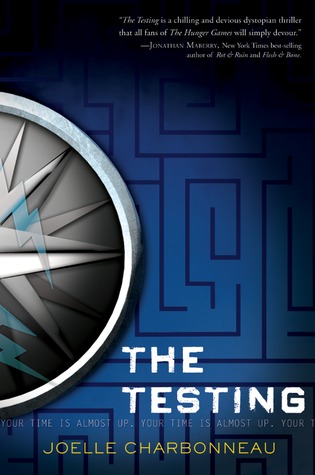
Review - The Testing
It will come as no great surprise that post-Hunger Games success there are a flood of teen lit books set in a dystopian future. Some will be good on their own and others will not. I was initially skeptical that this book would be too similar, but I found it enjoyable.
 The Testing by Joelle Charbonneau. 336 pages. Published in June 2013 by Houghton Mifflin. (An advanced copy used for this review)
Bottom Line:
Not great lit, not as good as The Hunger Games, but it will work for the kids who've already read that (and Divergent). Above average teen dystopian novel and a good choice for a summer read. Less likely to have cross over appeal to adults. Recommend that most medium or larger public libraries pick this up.
Living in a colony trying to reclaim the ground that has been destroyed by years of chemical warfare, Cia wants nothing more than to be chosen for "the testing" and earn the chance to compete for a spot in University. When she is chosen, she doesn't understand why her father and the other University grads are not happy for her. But Cia has underestimated the horrors of what she will face at the Testing. And then there is Tomas, a classmate for years, who seems to want more. But is romance the right decision when they are fighting for their lives? Can she trust anyone or anything?
A group of teens from a variety of different settlements thrown by their merciless government (post major disaster world) into a series of challenges and battles for their lives. Yeah that seems familiar. The difference between this and The Hunger Games is that the teens don't know (at first) how high the stakes are. Part of the suspense is watching the teens realize exactly how bad their situation is. Also the teens aren't being required to kill each other. It's different enough to be worth a read.
This is the first of a trilogy (isn't everything a trilogy now?) and I probably will read the second book. But I don't feel the HAVETOREADNOW that I have with other series. So by reading this first book, you are not necessarily committing yourself to a three book series. It really would work as a standalone story.
The characters themselves are well developed and distinct. Some behave precisely as you expect (including inevitable betrayals) while others are a complete surprise. I wish we had a bit longer with Cia and her family in the beginning so we were more invested in her emotionally (and the steps she takes to protect them).
The plot is fast moving enough that even when they were taking written tests, I was engrossed. There's enough mystery to keep you guessing (and will probably get me to read the second book). Much as Cia does not know what is coming, neither do you. The first written tests seem normal enough, and the setting up of a lab for some experiments not unexpected, but gradually each challenge becomes a little more surreal and the reader finds themselves as scared and bewildered as the students trying to survive. It is as we slip farther into the madness of testing that the book really begins to shine.
The setting was my favorite part of the novel. I'm a sucker for post-apocalyptic worlds. Judging by geographic clues this world's capital was in or near Kansas City so it gets some hometown love for me. What I really loved were the descriptions of the settlers trying to reclaim the land from the effects of chemical warfare and the mutilation of plants, animals, and ground water. I'm hoping we see more of that in future books.
There's not a lot more to say on this book. It is exactly what it purports to be, a pretty good teen dystopian novel. Solid on plot, concept, characters, setting. While it is not extraordinary, it is unusual to find a book that hits so solidly across the board. It will definitely find its fans.
Bottom Line:
Not great lit, not as good as The Hunger Games, but it will work for the kids who've already read that (and Divergent). Above average teen dystopian novel and a good choice for a summer read. Less likely to have cross over appeal to adults. Recommend that most medium or larger public libraries pick this up.
Living in a colony trying to reclaim the ground that has been destroyed by years of chemical warfare, Cia wants nothing more than to be chosen for "the testing" and earn the chance to compete for a spot in University. When she is chosen, she doesn't understand why her father and the other University grads are not happy for her. But Cia has underestimated the horrors of what she will face at the Testing. And then there is Tomas, a classmate for years, who seems to want more. But is romance the right decision when they are fighting for their lives? Can she trust anyone or anything?
A group of teens from a variety of different settlements thrown by their merciless government (post major disaster world) into a series of challenges and battles for their lives. Yeah that seems familiar. The difference between this and The Hunger Games is that the teens don't know (at first) how high the stakes are. Part of the suspense is watching the teens realize exactly how bad their situation is. Also the teens aren't being required to kill each other. It's different enough to be worth a read.
This is the first of a trilogy (isn't everything a trilogy now?) and I probably will read the second book. But I don't feel the HAVETOREADNOW that I have with other series. So by reading this first book, you are not necessarily committing yourself to a three book series. It really would work as a standalone story.
The characters themselves are well developed and distinct. Some behave precisely as you expect (including inevitable betrayals) while others are a complete surprise. I wish we had a bit longer with Cia and her family in the beginning so we were more invested in her emotionally (and the steps she takes to protect them).
The plot is fast moving enough that even when they were taking written tests, I was engrossed. There's enough mystery to keep you guessing (and will probably get me to read the second book). Much as Cia does not know what is coming, neither do you. The first written tests seem normal enough, and the setting up of a lab for some experiments not unexpected, but gradually each challenge becomes a little more surreal and the reader finds themselves as scared and bewildered as the students trying to survive. It is as we slip farther into the madness of testing that the book really begins to shine.
The setting was my favorite part of the novel. I'm a sucker for post-apocalyptic worlds. Judging by geographic clues this world's capital was in or near Kansas City so it gets some hometown love for me. What I really loved were the descriptions of the settlers trying to reclaim the land from the effects of chemical warfare and the mutilation of plants, animals, and ground water. I'm hoping we see more of that in future books.
There's not a lot more to say on this book. It is exactly what it purports to be, a pretty good teen dystopian novel. Solid on plot, concept, characters, setting. While it is not extraordinary, it is unusual to find a book that hits so solidly across the board. It will definitely find its fans.
Friday, July 12, 2013
Urban Fiction (Street Lit) Thoughts and a Review
Recently I used a portion of some grant funds to increase the size of our urban fiction collection. It circulates well here and we get a lot of requests for it. There are some core lists and resources for ordering urban/street lit, but not a lot. And those that do exist are often out of date. I relied heavily on Amazon best seller lists (and the "customer who bought this item also bought") feature.
This week as I pulled books that were no longer new from the new books into the general collection, I decided to read an urban lit book. The last one I read was The Coldest Winter Ever by Sister Souljah. That bestselling book is one of the best known of the genre. I suppose it would be like someone reading Outlander by Diana Gabaldon and declaring themselves done with romance novels. In other words, as an urban librarian, it was time for me to revisit the genre.
Let's talk about urban lit or street lit. Both terms are used frequently. I prefer the term street lit, but always seem to find myself typing urban lit. There are many ways to be urban and the lifestyle reflected in this books is only one choice, hence I prefer street lit. Some of my patrons ask for the "black books" and they don't mean Alice Walker and Toni Morrison. That bugs me and I'd rather not think too hard about it. So Street Lit it is!
For me there are several barriers to street lit. I'm not the intended audience and I know that. However exaggerated and extreme the storylines are, there is some basis in truth and that truth makes me uncomfortable. I have worked with urban and economically disadvantaged populations for over a decade. I comprehend the challenges they face, but I don't understand. Though I read all the articles, all the studies, talk to people, work with families, and even do home visits, I still go home to a nice place to live and a pantry full of food. I don't go home to a government subsidized apartment wondering how to make food stamps stretch through the end of the month while I divert my minimum wage paycheck to gas to get to that job. Comprehending is not knowing and I've never lived that life.
Reading urban lit is an uncomfortable experience as I am forced to confront the privilege afforded to me by my skin color, my education, my socioeconomic class, and my family. I am blessed to have a safety net a mile wide. If I lost my job, my savings, etc., I would not be forced, as the main character in this novel, to prostitute myself or sleep in my car. It's hard for me to evaluate a character's choices (and isn't that why we read literature to evaluate their choices and think what we would do) when her set of circumstances are so widely different than my own. My current book filled with upper and middle class characters making hard choices in Italy during WWII is some how more relatable than that of a lower income urban character in my own country and time. There is something wrong with that or perhaps something wrong with me. As I said, I've worked within those communities, but I've never lived within them. This is why the Vista program (the branch of Americorps that fights poverty) pays their volunteers at the poverty line so they can begin to understand the people they are trying to help.
And of course the most common criticism of street lit is the glorification of guns, drugs, and gang life. That's there. Absolutely. And I haven't read all of street lit, two books is hardly a statistically valid sampling, but the two I have read have had definite moral warnings against all of the vices they spent the first 2/3rds of their books glorifying. A bit of a mixed message or a very classic morality story (I did these things, they were fun, but then I paid for it).
Enough general blathering and on to the review.
 Shattered by Kia DuPree. Published in 2012 by Grand Central Publishing. 384 pages.
Bottom Line: Recommended for a library with a street lit collection. Strong female protagonist and likely to appeal to women readers. Definitely will appeal to fans of Sister Souljah. (I don't know enough of this genre to know more of the cross appeal.)
When Kiki's partially deaf mother loses custody of her children, and Kiki enters the foster care system her life begins to crumble. She runs away from the foster home and into the arms of a pedophile, abuse, and prostitution. Even as an adult reunited with her family, those patterns continue for her and her family. As she struggles against a life of pimps, boyfriends, drugs, gangs, and violence, she makes hard choices about her future.
Most obvious thing about this book: it is written in vernacular. To me the grammar feels wrong and it is grating. It is an intentional choice. To the credit of the author, the character and plot was enough to keep me engaged through the first twenty pages. After that the speech patterns and grammatical choices felt natural and organic to those characters and that setting. As such they faded into the background and allowed me to enjoy the book. This is a great triumph for the author since the first 20 pages I was itching to grab a red pen.
Please note I don't have perfect grammar either. So I definitely should not be judging harshly. It is just that this dialect of English is different similar enough to my own that instead of seeing it as a different dialect, I see it as a series of mistakes. That the author brought me past that surprised no one more than me.
Beyond all the general issues mentioned above, my biggest problem with this book is that it is "abuse titillation". "Abuse titillation" is the term I use to refer to the joy we all take in reading of gross misfortune endured by others. This primarily seems to be a female trait. Elementary school girls read about the Holocaust, middle school girls read A Child Called It, high school girls read V.C. Andrews, and adult women read true crime. Even Law & Order had a SVU spinoff just for their "special victims unit", capitalizing on this country's fascination with crimes committed against our most vulnerable.
For me one of the hallmarks of this abuse genre is lingering descriptions of the abuse. Shattered includes rape, pedophilia, prostitution, and consensual sexual acts. All of them are described in blunt, crude terms. However the abusive acts are described in noticeably greater detail than any of the consensual (and supposedly pleasurable) sexual acts. That speaks volumes about which parts the author expects the reader to find interesting.
The last problem I want to discuss with this book is faux feminism. (Warning this paragraph and the next contain a lot of spoilers.) In theory Kiki transitions from weak scared little girl to strong woman capable of handling herself. She almost does. In the pivotal scene where the bad guy is struggling to kill her, her fingers touch the gun (almost) and just as she is about to turn and defend herself, her boyfriend kills him. As she is shaking and crying in the aftermath, she has her great emotional reveal. In one paragraph she tells him and the reader (TELLS NOT SHOWS, one of my pet peeves) just exactly how she has emotionally grown. Her boyfriend's response? He tells her she is really a "grown up girl" now. I almost threw up when I read that. It completely cheapens any emotional growth she had and minimizes her as a character/person. (Also that paragraph of emotional reveal denies the reader any joy of discovery and instead hands them a conclusion on a silver platter. I prefer a more subtle handling of catharsis wherein the reader has to do some of the work and thus shares in the emotional journey instead of being a voyeur watching a completed tableaux.)
At the conclusion, Kiki has her grand moment wherein she tells her story to a group of at risk teen girls at a charity fundraiser. It's always a nice trope for our heroine at the advanced old age of 21 to be a role model to younger teens. However I still can not find any evidence of where she is extremely admirable and strong. There's a great moment at the airport where she breaks away from her captor and that's it. She was strong to survive, and I'm not downplaying that, but only one moment of self-rescue. Even her new suburban life is courtesy of her boyfriend not due to any education or job prospects of her own. She pulls herself out of trouble but can't rise above her circumstances. I felt a little bit that without her boyfriend she would be back to part time shampoo girl and part time call girl. And that hurts the feminist in me, especially because it is subtle enough to be missed in what is trying desperately to be a strong woman story.
That's a lot of overthinking for a book review. If you want to have a street lit collection, this would be a good choice. Overall it looks better than Welfare Wifeys, but I haven't read that tome so I can not really say. It has circulated well at my library.
This week as I pulled books that were no longer new from the new books into the general collection, I decided to read an urban lit book. The last one I read was The Coldest Winter Ever by Sister Souljah. That bestselling book is one of the best known of the genre. I suppose it would be like someone reading Outlander by Diana Gabaldon and declaring themselves done with romance novels. In other words, as an urban librarian, it was time for me to revisit the genre.
Let's talk about urban lit or street lit. Both terms are used frequently. I prefer the term street lit, but always seem to find myself typing urban lit. There are many ways to be urban and the lifestyle reflected in this books is only one choice, hence I prefer street lit. Some of my patrons ask for the "black books" and they don't mean Alice Walker and Toni Morrison. That bugs me and I'd rather not think too hard about it. So Street Lit it is!
For me there are several barriers to street lit. I'm not the intended audience and I know that. However exaggerated and extreme the storylines are, there is some basis in truth and that truth makes me uncomfortable. I have worked with urban and economically disadvantaged populations for over a decade. I comprehend the challenges they face, but I don't understand. Though I read all the articles, all the studies, talk to people, work with families, and even do home visits, I still go home to a nice place to live and a pantry full of food. I don't go home to a government subsidized apartment wondering how to make food stamps stretch through the end of the month while I divert my minimum wage paycheck to gas to get to that job. Comprehending is not knowing and I've never lived that life.
Reading urban lit is an uncomfortable experience as I am forced to confront the privilege afforded to me by my skin color, my education, my socioeconomic class, and my family. I am blessed to have a safety net a mile wide. If I lost my job, my savings, etc., I would not be forced, as the main character in this novel, to prostitute myself or sleep in my car. It's hard for me to evaluate a character's choices (and isn't that why we read literature to evaluate their choices and think what we would do) when her set of circumstances are so widely different than my own. My current book filled with upper and middle class characters making hard choices in Italy during WWII is some how more relatable than that of a lower income urban character in my own country and time. There is something wrong with that or perhaps something wrong with me. As I said, I've worked within those communities, but I've never lived within them. This is why the Vista program (the branch of Americorps that fights poverty) pays their volunteers at the poverty line so they can begin to understand the people they are trying to help.
And of course the most common criticism of street lit is the glorification of guns, drugs, and gang life. That's there. Absolutely. And I haven't read all of street lit, two books is hardly a statistically valid sampling, but the two I have read have had definite moral warnings against all of the vices they spent the first 2/3rds of their books glorifying. A bit of a mixed message or a very classic morality story (I did these things, they were fun, but then I paid for it).
Enough general blathering and on to the review.

Bottom Line: Recommended for a library with a street lit collection. Strong female protagonist and likely to appeal to women readers. Definitely will appeal to fans of Sister Souljah. (I don't know enough of this genre to know more of the cross appeal.)
When Kiki's partially deaf mother loses custody of her children, and Kiki enters the foster care system her life begins to crumble. She runs away from the foster home and into the arms of a pedophile, abuse, and prostitution. Even as an adult reunited with her family, those patterns continue for her and her family. As she struggles against a life of pimps, boyfriends, drugs, gangs, and violence, she makes hard choices about her future.
Most obvious thing about this book: it is written in vernacular. To me the grammar feels wrong and it is grating. It is an intentional choice. To the credit of the author, the character and plot was enough to keep me engaged through the first twenty pages. After that the speech patterns and grammatical choices felt natural and organic to those characters and that setting. As such they faded into the background and allowed me to enjoy the book. This is a great triumph for the author since the first 20 pages I was itching to grab a red pen.
Please note I don't have perfect grammar either. So I definitely should not be judging harshly. It is just that this dialect of English is different similar enough to my own that instead of seeing it as a different dialect, I see it as a series of mistakes. That the author brought me past that surprised no one more than me.
Beyond all the general issues mentioned above, my biggest problem with this book is that it is "abuse titillation". "Abuse titillation" is the term I use to refer to the joy we all take in reading of gross misfortune endured by others. This primarily seems to be a female trait. Elementary school girls read about the Holocaust, middle school girls read A Child Called It, high school girls read V.C. Andrews, and adult women read true crime. Even Law & Order had a SVU spinoff just for their "special victims unit", capitalizing on this country's fascination with crimes committed against our most vulnerable.
For me one of the hallmarks of this abuse genre is lingering descriptions of the abuse. Shattered includes rape, pedophilia, prostitution, and consensual sexual acts. All of them are described in blunt, crude terms. However the abusive acts are described in noticeably greater detail than any of the consensual (and supposedly pleasurable) sexual acts. That speaks volumes about which parts the author expects the reader to find interesting.
The last problem I want to discuss with this book is faux feminism. (Warning this paragraph and the next contain a lot of spoilers.) In theory Kiki transitions from weak scared little girl to strong woman capable of handling herself. She almost does. In the pivotal scene where the bad guy is struggling to kill her, her fingers touch the gun (almost) and just as she is about to turn and defend herself, her boyfriend kills him. As she is shaking and crying in the aftermath, she has her great emotional reveal. In one paragraph she tells him and the reader (TELLS NOT SHOWS, one of my pet peeves) just exactly how she has emotionally grown. Her boyfriend's response? He tells her she is really a "grown up girl" now. I almost threw up when I read that. It completely cheapens any emotional growth she had and minimizes her as a character/person. (Also that paragraph of emotional reveal denies the reader any joy of discovery and instead hands them a conclusion on a silver platter. I prefer a more subtle handling of catharsis wherein the reader has to do some of the work and thus shares in the emotional journey instead of being a voyeur watching a completed tableaux.)
At the conclusion, Kiki has her grand moment wherein she tells her story to a group of at risk teen girls at a charity fundraiser. It's always a nice trope for our heroine at the advanced old age of 21 to be a role model to younger teens. However I still can not find any evidence of where she is extremely admirable and strong. There's a great moment at the airport where she breaks away from her captor and that's it. She was strong to survive, and I'm not downplaying that, but only one moment of self-rescue. Even her new suburban life is courtesy of her boyfriend not due to any education or job prospects of her own. She pulls herself out of trouble but can't rise above her circumstances. I felt a little bit that without her boyfriend she would be back to part time shampoo girl and part time call girl. And that hurts the feminist in me, especially because it is subtle enough to be missed in what is trying desperately to be a strong woman story.
That's a lot of overthinking for a book review. If you want to have a street lit collection, this would be a good choice. Overall it looks better than Welfare Wifeys, but I haven't read that tome so I can not really say. It has circulated well at my library.
Subscribe to:
Posts (Atom)