Friday, September 27, 2013

Review - Burial Rites

Lately in Anchorage, it has been gray and rainy. This typical fall weather in Alaska always makes me want to curl up in a chair with a cup of tea and a book that helps me forget the rest of the world. I had an advanced ecopy courtesy of NetGalley that perfectly fit the bill. The weather in the book was also often cold and overcast: perfect match!

Burial Rites by Hannah Kent. Published September 2013 by Little, Brown and Company, 336 pages.

Bottom Line: Highly recommended. A melancholy look at life in early 19th century Iceland and the last person to be executed in that country. Really good at exploring themes of loneliness, relationships, redemption, and society. Fascinating glimpse into Icelandic society. Should be picked up by most public libraries. Will appeal to historical fiction fans and literary fiction readers.

In 1829 in Iceland, two men have died horrible deaths and three people are tried for the crime. Two are sentenced to death and one to life in prison. While they await confirmation of the sentence from the ruling Danish officials, Agnes is moved to a farm in the valley where she grew up to be held prisoner in the home of a minor government official.

Of course the official and his family have no prison on their land, so Agnes lives with the family as a servant, gradually revealing her own story and becoming part of that family's story.

Utterly fascinating. I didn't know much about life in Iceland and I loved this peek at how it worked. For example I didn't know that Iceland was ruled over by the Denmark (and the Danish King) from the 13th century until the end of WWII. All the little details about life in such a harsh Northern climate, on farms where people were barely surviving were beautifully woven into the story. At no point did you feel like you were receiving a history and sociology lesson, but rather that you were seeing into their society. (It should be noted that the author is an Australian who has spent considerable time in Iceland.)

The setting is dramatically described as both culturally and physically harsh. Flashes of Agnes' life are revealed as we see how hard it was to be an unwanted child, a servant, in a time where survival was not guaranteed even for the wanted children of well off farmers.

Writing is lyric and melancholy. Haunting and mesmerizing are adjectives used to describe books so often as to become meaningless cliches, but they apply.

What I loved about this book that I didn't realize how much I enjoyed it until after a few weeks of deliberation was the lack of didactic moralizing. This isn't a story against the death penalty. It is just a story, just a thing that happened. Steinbeck did the same type of storytelling with Of Mice and Men. These are the tales of how people live, how horrible things can happen without horrible intentions, how life can be hard, survival a challenge and beauty still exist.

As a funny note, I read this as an ebook advanced copy from NetGalley. The library's copy arrived on Wednesday. On Thursday a high schooler arrived with an assignment to read any book more than 250 pages not by an American author. I book talked this one to her and she left with it very happily. Fortuitous timing.

Saturday, September 07, 2013

Review - The Returned

Please don't let the fact that this is published by Harlequin dissuade you. There's nary a heaving breast or throbbing member to be found. Instead you have some very well written speculative fiction.

The Returned by Jason Mott. Published by Harlequin, August 27th, 2013. 352 pages.

Bottom Line: Not a flawless book, but a very good book. Focusing more on human nature and relationships than supernatural, it is a nonetheless eerie book that succeeds in getting under the skin of the reader. Recommended for purchase by most librarians. Will appeal to fans of China Mieville and Carlos Ruiz Zafon.

All around the world, the dead are returning. They're not coming back as zombies or ghosts or vampires (not that type of novel), they're just coming back. Thousands of miles from home, with no memories of the afterlife, just returning in much the same condition they were when they died. This presents problems when, for example, a group of Nazi soldiers comes back in a small town in rural America. At first the Bureau tries to reunite the returned with their families, but not every returned is welcomed back. They bring out a lot of complicated feelings. And the problems grow as the numbers of returned grow.

At the heart of the novel is the small town where the Hargraves live. They face complicated feelings when their young son, drowned nearly 50 years earlier, is returned. And then their town is taken over for a detention center for the returned. As tensions burn between the returned, the soldiers, and the "True Living" townsfolk, no one is ready for the chaos.

The concept is fascinating. The dead returning as almost but not quite living with no explanation. The reader receives no more explanation than did the people of the novel allowing us to share in the mystery and frustration.

The setting is incredible. You see this small town, a bit run down by the economy, filled with people who aren't good or bad but just people, and you feel like you could live there. Or that you do. Because it is every small town, but it is also its own place.

Characterization was fantastic. Even the "villains" are fully developed complex characters. No one was predictable. Some of the characters I thought I knew the best managed to surprise me right at the end, but surprise me in a way that was consistent with their character and shed light on every previous action. In other words, some of the best characterizations I have ever felt.

Great premise. Fantastic setting. Incredible characterization. Mediocre plot. The plot pacing was uneven. And that kept everything from entirely gelling together. This book was very good, but just short of great.

Between the chapters about the main characters, there are interludes written from the point of view of a returned. These are some of the most beautiful and haunting, little glimpses into the confusion. They were some of my favorite parts of this novel. I think I would really have enjoyed seeing this novel as a series of short stories set in the world dealing with this returning of the dead.

But I can't wish for a book that doesn't exist. And I did really enjoy this book. I do recommend it. It's speculative fiction without being hardcore, returning from the dead without being zombies, paranormal but not frightening, it does what great literature does, it makes us look within ourselves to ask how we and our neighbors would handle a situation.

Tuesday, September 03, 2013

Change is Hard

One of my new goals is to read at least one book that might help me be a better librarian or manager a month. They don't all have to be actually aimed at librarians, but I will be reviewing them under the tag "professional lit". To that end my first book was about change. It was the August book, but I am a bit delayed on the blogging.

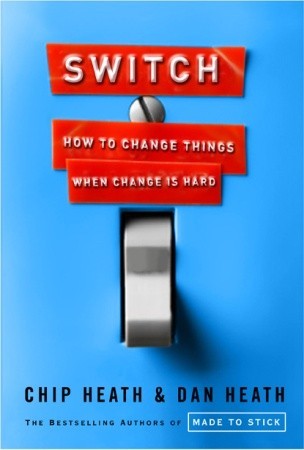
Switch: How to Change Things When Change is Hard by Chip Heath and Dan Heath. Published in 2010 by Crown Business. 320 pages.

Change is ever present in our personal and work lives. A lot is being written about how libraries are facing a crisis/ebook revolution/time of change. And yeah. But that was also true when we went to computers and integrated library systems (ILS for the acronym geeks out there). It was true when we dumped the card catalog and went to OPACs (online public access catalogs). It was true when we racially integrated libraries. Back in the 16th century there was probably a librarian grousing that switching to the Gregorian calendar would really mess up the acquisition records.

Okay a lot of those things happened before my time in librarianship. But my point is that we have always been a profession who faced change.

My library system has been going through a lot of change. As a middle manager, I've been responsible for helping to implement some of that change, but I have not always been in on the meetings or decisions to make that change. And of course my personal life has had a lot of change lately, some good some not so good. Thus change and change management are of special interest to me.

Bottom Line: This book is really good. You should read it if you are interested in change or management. It has a good basic framework that is supported with practical examples from business, social work, non profits, and personal life. It avoids the trap of speaking too much in scholarly jargon and produces an approachable book that doesn't feel dumbed down.

Basic framework: To make change happen, balance the rational and emotional parts of people's minds. Give motivation to their emotional part of the brain and clear direction to their rational part.

I'm not going to quote the entire book verbatim, but here are a few relevant examples.

Clear direction to the rational part of the mind. For example we could say "be more friendly and welcoming to the patrons". That's really vague. Most staff think they are friendly and welcoming, regardless of how they are perceived. A few years ago we heard a good framework at a customer service training. It's the 10-4 rule. When a patron is within 10 feet of you, make eye contact and smile. Acknowledge them non-verbally. The patron feels welcomed and is more likely to approach you if they need help. When a patron is within 4 feet of you, verbally greet them. Super easy and works like a charm. This very clear directive makes a world of difference in customer service.

Another great piece of advice. Shrink the change. Don't make people change the world all at once, give them small achievable steps.

Give people a head start. The example in the book was of a car wash that gave some customers a loyalty 8 punch card (and then the 9th was free) and other customers a 10 punch card to earn a free wash. The customers with the 10 punch card were told they were given two free punches for loyalty. So both groups had to earn 8 punches for the free wash. The customers who thought they had a two punch head start were more likely to complete their punch card.

We did something very similar with summer reading this system. When our youth services librarians visited schools, they gave out a large bookmark style summer reading promo that also had the first few lines of the summer reading chart so kids could start tracking the time they were reading. They were really excited to get a "head start" on their reading and were already invested in the program and (hopefully) more likely to come in and sign up.

Last crumb from the book: tweak the environment. To make change work, to make it easier and more likely to stick, change the environment in favor of the change. Years ago I worked at a library that wanted more people to use self check machines (staff cuts, staff reduced by attrition, more effective). Rather than just putting up a self check and hoping for the best, they totally redid the circulation desk. Instead of 3 clerk stations and one self check, you had to walk past four self checks to get to the only clerk station. That, and friendly staff members offering to help them use the self check, really helped people convert to self checks.

My favorite comment of that system, when someone worried that seniors wouldn't be able to deal with the new machines, was from my branch manager. He replied that those same seniors had been using ATMs happily for 20 years. And it really wasn't a problem.

In summary: this is a great book for librarians and managers and I highly recommend it. It has given me a lot to think about in terms of change in our system and in my own life personally.

Friday, August 16, 2013

Review - The Wicked Girls

Published first in the UK (last year) and in the United States this summer, I got an advanced copy of the US edition Wicked Girls from the Early Word program. This is not a book I would have normally picked up, but I could not put it down. Perhaps I like mysteries/thrillers more than I thought I did or perhaps this book is just THAT GOOD.

The Wicked Girls by Alex Marwood. 378 pages. UK version published by Sphere in 2012, US version published July 30, 2013 by Penguin.

Bottom Line: Recommended for most all public libraries. Great summer read. Would appeal either to mystery fans of sociological issues fans (ie Jodi Piccoult).
Two 11 year-old girls suffering from different and very similar lives of neglect meet for one summer day. At the end of that day, they are murderers. Their subsequent prosecution, imprisonment, and release under a protection program that changes their identities all come to a head 25 years later. Kristy is a journalist covering a serial killer and Amber is a cleaning supervisor who has found one of the victims. Switching between the current series of murders and their fears for the lives they've established should their secret be revealed.

When a child commits a terrible crime, there is a lot of speculation in the media on why (bad parenting, violent video games, natural sociopath, pick your disorder du jour). This book can not and does not try to give an overarching reason. Instead it tells a very plausible story of two girls, one awful day, and the adults they become.

At no point is this an apologetic tale, the horror of what happened and the culpability of all involved is never sugarcoated. However for those of you like your thriller with a healthy dose of psychological introspection, Marwood has written a fantastic tale for you.

Setting: an economically depressed, working class town on a cold rainy coast in Britain. It is perfectly described. Have you read The Working Poor or Nickel and Dimed? What I love here, beyond the obvious thriller/mystery, was the contrasts of the recession on Kristy (solidly middle class but struggling with her husband out of work) and Amber and her working class/minimum wage colleagues. Fantastically done, insightful societal portraits. Ultimately, that is why this appeals so much more to me than your average mystery. The vivid characters, detailed setting, and multifaceted look at a society's larger issues are incredibly compelling. More than the mystery, that keeps the reader turning the pages and thinking about it long after you have finished reading.

Oh yeah and the mystery is good and fast paced. You will want to know what precisely happened on the day when they were children and who is killing people now. I had called out the red herring and the real murderer pretty early though. But it wasn't enough to stop me from reading the rest of this book as it usually does with mysteries. Seeing how Marwood would get us to the end kept me reading. Overall this is just a fantastic book.

Thursday, August 15, 2013

Orson Scott Card, censorship, and questionable morality

Orson Scott Card's Ender's Game is finally going to be made into a movie. I could not be more excited. I might have had a barely contained squeal in the theater the first time I saw a trailer. Love those books. I've loved most everything I've read by Orson Scott Card and I've read most of his works that aren't barely disguised allegories for Mormon theology.

Oh yeah, Orson Scott Card is a member of the church of Jesus Christ of Latter Day Saints, a religion not known for its tolerance. And he was a board member of the National Organization for Marriage until very recently. And by marriage, that group means only heterosexual marriage.

For this and similar reasons, a group of LGBTQ geeks has organized a boycott of Ender's Game called Skip Ender's Game.

I agree with their sentiments, mostly. The New York Times has an editorial that explains it better than I probably will. Basically this is a bit different than the Chik-Fil-A boycott. Their profits were being directly funneled into anti-gay causes. And creators have throughout history had crazy opinions separate from their creations.

That said, it is possible I am making excuses because I really want to see this movie. I don't know. Perhaps the best reason to boycott it is the likelihood it will be a disappointment. I should keep Petra, Ender, Bean, and all my other battleschool friends the way they look in my head.

I could not watch it in theaters and grab the DVD from the library (the library will buy the number of copies it does based on other factors, not my borrowing habits) for free instead of giving it money directly at the theater or indirectly through Netflix.

And it wouldn't end my life to skip it entirely. I'm just not sure that it will make any difference. Do you know what makes a difference in these types of social issues? For every loud mouth bigot, that there are 10 or 100 people quietly living their lives. Because when you know a couple who has been together, committed and in love for years but able to have any legal protections, your mind starts to change. When you realize that it is fine for your church to not perform the marriage, but that has nothing to do with the state defined contract of marriage and those protections, your mind changes. (For example the Catholic church wouldn't marry my husband and I because neither of us are Catholic or willing to raise children Catholic, but they have no problem with the state of Alaska recognizing our marriage.) And when people in the public eye, quietly come out, newscasters and sports figures, actors, child stars, and singers, that is when mind changes. Honestly, I'm not sure Card has as much influence here.

Orson Scott Card has a vivid imagination. Too bad he doesn't stick to science fiction, but instead uses it to imagine that Obama is recruiting an army of urban gang members. Too bad he has some views that I hate. But does that invalidate all of his contributions in terms of artistic merit? As the Times article linked above is this a form of blacklisting because we don't like his politics? Didn't we (rightfully) hate on McCarthy for doing the same thing? Ender's Game has nothing to do with gay marriage, so why can't we enjoy it for what it is?

What is a socially conscious geek girl to do?

Saturday, August 03, 2013

Body-Positive Self-Esteem Storytime

This is a very quick blog post started by a conversation on Twitter. MagpieLibrarian (aka Ingrid) whom I've never met, but I saw once at ALA and was too shy to say hi, put up a very cool body-positive display in her tween/teen area. You can read all about it here. Also apparently, I am the only person who is hyphenating body positive so I'll stop that.

Then I mentioned that I used to do body positive/self-esteem storytimes as part of my regular rotation of storytimes. There's a million studies out there about negative self-esteem, especially in girls, and how young it starts. We've all seen the articles about the sexualization of Strawberry Shortcake and even My Little Pony. If the marketers are starting that early, anyone who wants to be on the other side of this fight should too. Lest the parents believe I'm pushing an agenda, I call it "I Like Me" storytime.

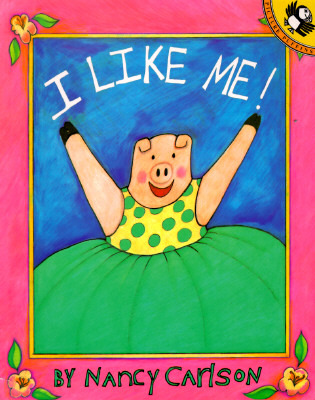
I first got the idea for this story from Nancy Carlson's classic book I Like Me where a vivacious pig lists all the things she likes about herself including her round little tummy. She lists all the great stuff she can do, including ride her bike fast, how she keeps trying after she makes a mistake, and the ways she takes care of herself. But my favorite page is where the pig in her pajamas (admittedly a retro baby doll pajama set but not at all a sexualized look) greets herself every morning with "Hi, good-looking!" It usually makes all the moms laugh, but that is in the tone of voice you read, I camp it up.

There are a whole host of great books available for preschoolers to do a storytime. Many of them are short enough that it is possible (I've done it) to use as a lapsit/toddler program. I'm publishing my list from the last time I did this storytime in 2011. And even then I remember not putting all the books in the packet. Clearly we read 3-4 books at storytime, but we made packets for the entire system that had more books so each librarian could choose their favorites.

While I try to keep up with children's literature, I've fallen a bit behind on picture books since I'm now a branch manager. Please comment on if you know any more.

Possible Picture Books to use:
Incredible Me by Kathi Appelt
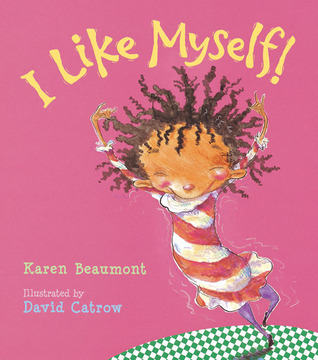
I Like Myself! by Karen Beaumont
Nobody Laughs at a Lion by Paul Bright
I Like Me by Nancy Carlson
I'm Gonna Like Me by Jamie Lee Curtis
Alfred's Nose by Vivienne Flescher
Dog Eared by Amanda Harvey
Happy to Be Nappy by Bell Hooks
Leo the Late Bloomer by Robert Kraus
Good Thing You're Not an Octopus by Julie Markes
I'm A Pig by Sarah Weeks
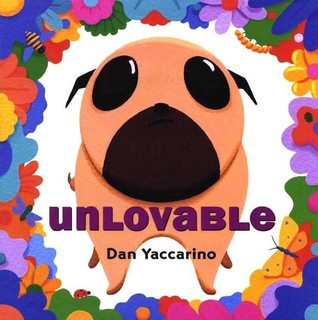
Unlovable by Dan Yaccarino

Flannel board/told stories:
I like to do one flannel or magnet board story at each storytime. It's fun, breaks the rhythm, and helps kids who learn differently. The Ugly Duckling is a really good choice out there. If you're in one of those libraries that has a huge filing cabinet full of flannel boards (man I love those things), odds are better than even that you have one for The Ugly Duckling already.

If you don't, you can make one. I promise. I'm not that artistic (I'm crafty but I can't draw) and I've done it. Or you can cheat and do a magnet board. We had a two sided board with flannel on one side and magnetized white board on the other. Go to the craft store, buy the magnets that come in strips and are sticky on one side. Start googling around for duckling and baby swan (cygnet) templates. (I recommend adding the words "coloring page" to your search.) Print them out the appropriate size. Color in brightly with markers (pinch yourself because you're getting paid to color). Laminate them; if you don't have access to a laminating machine I don't know how you can call yourself a youth services librarian; I laminated everything in sight in my YS days. Attach magnets. Take dry erase markers and draw a lake and some weeds and a nest and some eggs. Voila! Storytelling stage set!

Songs:
Any body song will work here as well any of those rhymes where you "clap your hands, stamp your feet, turn around, take a seat". I'll list a few to get you started.
Heads, Shoulders, Knees and Toes
The Hokey-Pokey (under no circumstances should you ever in your life turn down an opportunity to do the Hokey-Pokey).
Do Your Ears Hang Low?
If You're Happy and You Know It
Shake Your Sillies Out (Raffi)

Here's one of my favorite body movement rhymes (no tune). Make the actions match the words:

Hands on Shoulders
Hands on shoulders
Hands on knees
Hands behind you, if you please
Touch your elbows
Then your nose
Touch your hair
Now touch your toes.
Raise hands up high
Wave hello
Stretch your arms (arms to the side)
And watch you grow
Then bring hands down
Touch the floor
Now clap your hands,
ONE TWO THREE FOUR!
 
And one song I wrote (use however you want, just give me, Elizabeth Moreau Nicolai, credit if print)
 
I Like Me
(to the tune of "Three Blind Mice")
I Like Me (point to self)
I Like Me
So Very Much (hug ones self)
So Very Much
I can jump up high and touch the sky (jump up with arms pointing up)
I can jump up high and touch the sky
I Like Me
I Like Me
 
Following verses, all the same except third stanza which you substitute for other actions. Here are two of my favorites.
I can run faster than a tiger (jog in place)
I can dance and do the twist (dance, twist)
 
Craft:
Clearly you need to have outlines of body shapes (the generic could be a girl or boy one) and let the kids color themselves. For more fun, have random shapes of random colors of paper and they can glue them on for clothes. I used to save all my random scraps of paper for this and making monsters. Recycling! Go fancy with yarn to glue on for hair and googly eyes or eye stickers. Best storytime ever: a little girl glued on purple hair because someday she would have purple hair but mommy wouldn't let her now. I hope she got it.
 
There you go, a super fun, easy storytime to promote body positive thinking! Happy Reading!

Friday, August 02, 2013

Review - Life After Life

Sometimes I like to pair books with audiobooks the way other people pair wines with meals. I paired this with Cloud Atlas by David Mitchell (on audio) and it was a lovely matching. Reincarnation that isn't quite reincarnation in both cases. Beautiful combination.

Life After Life by Kate Atkinson. 529 pages. Published in April 2013 by Reagan Arthur Books.

Bottom Line: I can not say enough good things about this book. It's a wonderful character based relationship drama, beautifully written with a fascinating plot device. Will appeal to fans of Kate Morton. Good choice for book clubs. Recommended for all libraries.
In 1910 Ursula Todd is born and dies due to a cord wrapped around her neck. But then again on that same night she is born and this time the doctor makes it to her house and she lives. So it goes throughout her life, she dies and the next time manages to change events. Vague memories of previous lives haunt her with a constant since of deja vu. But with a life that spans two wars, a depression, and a flu epidemic can she use this to change more than just her own fate and that of the ones she loves?

This is a seriously fantastic concept. I've never seen reincarnation approached in quite this way before (the closest perhaps is The Butterfly Effect but this is much better done). The reliving of lives leaves Ursula able to make different choices as she grows older and as such affect not only if she lives, but those around her. Of course her constant since of deja vu leads to its own problems.

The language Atkinson uses is beautiful, it is as repetitive and circular as is Ursula's life resulting in a melancholy, ethereal quality. Such revisits and repeats of scenes as we relive Ursula's life could be tiresome and redundant, but they aren't. With each return to a scene it is framed slightly differently and we learn something new about the characters. It's brilliant.

The setting is ideal for such a plot device. A girl who watches her father fight in one world war, the entire world set back by a flu epidemic, and then her brothers and friends fight in another world war is uniquely poised to do something if she has a pre-knowledge of history. England of the countryside and London are starkly rendered. I felt as cold and bone-weary as Ursula did as she searched bombed buildings for survivors during the Blitz.

And let's talk about the ending. (No spoilers, promise!) When you have a main character who constantly gets to relive her own life, it would be possible to never end your story and almost impossible to really end it. While everyone of the 529 pages are worth it, I did wonder how she would end it. And how she did still leaves you with a lot of questions, but also a lot of satisfaction. I chose to believe that each time she restarted and changed something she created a new parallel universe, but I read too much scifi. And thus we ended in the universe that the author wanted us to live in.

Please note this book is not scifi by any stretch of the imagination. I'm sure it gets classified as "women's lit" but I hate that term. I'm going with literary fiction because of how wonderfully written and carefully constructed it is. Just go read it.